
My Story: Nic Granger OBE
Charting the Course: My TechWomen4Boards Finalist Story
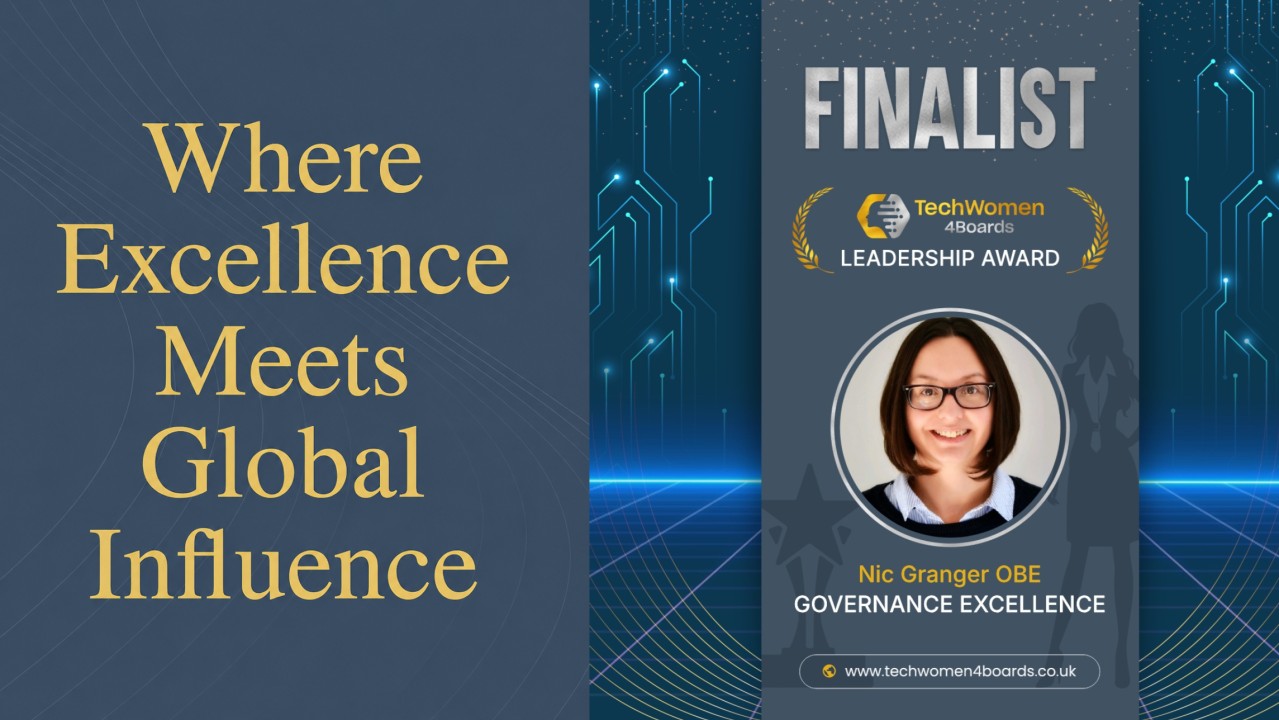
By Nic Granger OBE
I often say my technical skills peaked at age nine.
I started coding on a ZX Spectrum when I was about seven, writing simple programs, breaking things, and figuring out how they worked. It gave me an early sense of what technology could do, but also something more important: curiosity. That stayed with me, even as my career took a less structured path into roles focused on data, systems and organisational leadership.
From the outset, I’ve been drawn to making technology useful. I started with a degree in Business Information Systems, but my career quickly became less about specialism and more about breadth, working across healthcare and government to get the right data into the hands of the people who needed it. That meant translating between technical possibilities and operational reality, and understanding how organisations actually function. That theme has stayed with me: not just building capability, but making sure it delivers outcomes.
My time in the Falkland Islands was one of the most formative parts of my career. It’s not every day you move somewhere where penguins outnumber people, and that sense of difference shifts your perspective. What was meant to be a two-year move turned into nearly a decade, giving me the chance to explore both an extraordinary place and a much broader set of roles than I might otherwise so early in my career.
In a small, remote administration, you don’t stay in your lane for long. I found myself working across finance, systems, policy and operations, getting involved wherever there was a problem to solve. That experience built confidence and adaptability, but more importantly it gave me an early understanding of how decisions get made, how organisations respond under pressure, and how leadership shows up in practice. It’s shaped how I think about running organisations, not just transforming them.
At the North Sea Transition Authority, I’ve led large-scale data and digital transformation during a period of significant change for the UK energy sector. A key milestone has been the creation of the National Data Repository, now widely used across industry, academia and government to inform decisions on carbon storage, offshore wind and energy security.
But the technology itself is only part of the story. Transformation at scale is fundamentally about people, how you build trust, align purpose and create momentum across organisations with different roles and priorities. Particularly in regulated environments, progress depends on bringing others with you, not just delivering a system. That has meant a strong focus on collaboration, governance and clarity of intent, alongside delivery.
My approach has been pragmatic: start with outcomes, work iteratively, and create the conditions for teams to succeed. I’ve been fortunate to work with multidisciplinary teams who have turned complex ideas into tangible capability, and that collective effort was recognised with an OBE for services to digital transformation.
Alongside my executive role, I’ve deliberately built a portfolio in board governance. As Chair of The Data Lab Governance Board, Scotland’s innovation centre for data and AI, I’ve focused on long-term value, responsible innovation, and ensuring the right skills and capabilities are in place.
I’ve also had the opportunity to serve on boards shaping how organisations use digital, data and technology, from BCS, the Chartered Institute for IT, influencing the direction of the profession, to CAST, where the focus is on how the charity sector can make better use of these tools. My time in the Falklands also sparked a lasting interest in conservation, which led to my role on the board of the Bat Conservation Trust. Together, these experiences have strengthened my interest in organisational leadership, how strategy, culture and governance come together to deliver sustained impact.
My career has followed a deliberately unstructured path, spanning finance, technology, data and transformation, with detours through penguins in the Falklands and bats in the boardroom. That range of experience has shaped how I think about leading organisations, not just transforming them. Across it all, the focus has been on turning technology into real-world outcomes. The tools have changed a lot since my ZX Spectrum days, but the principle hasn’t.