
My Story: Liubov Shchigoleva
Charting the Course: My TechWomen4Boards Finalist Story
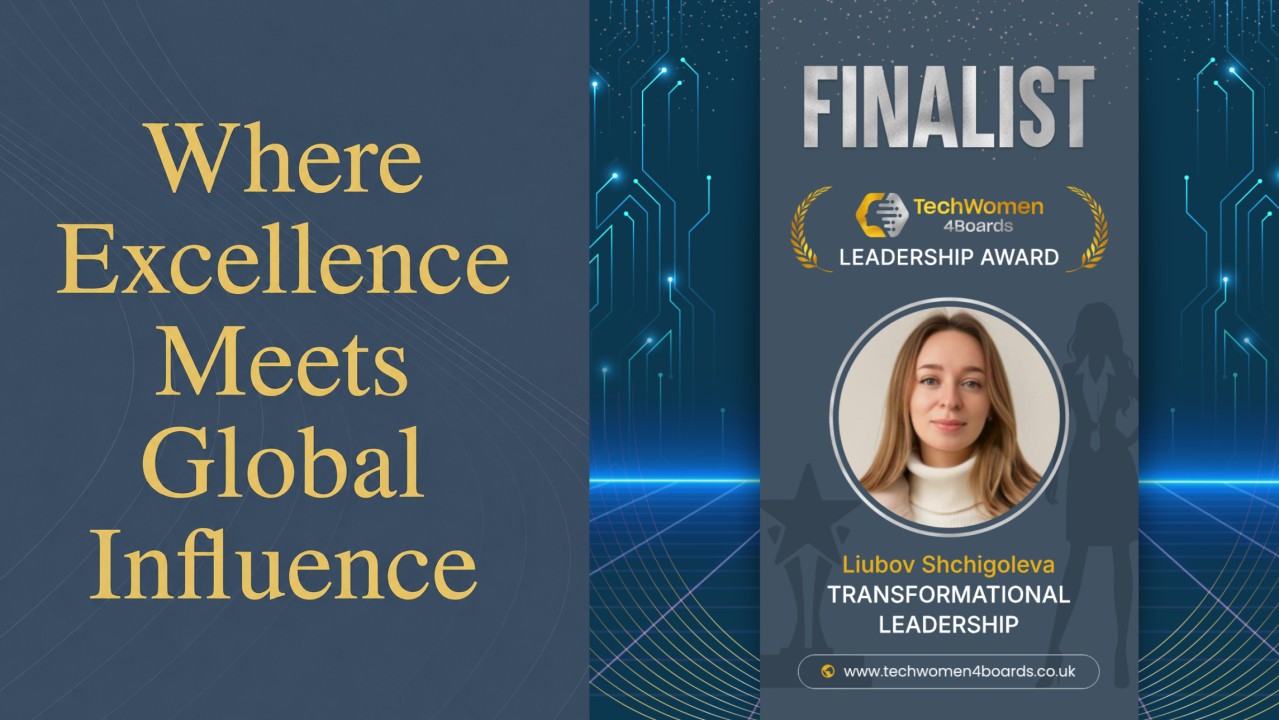
By Liubov Shchigoleva
I have always been drawn to the space between what is promised and what actually works. That gap — where user expectations meet operational reality — is where I have spent most of my career, and where I have learned everything that matters to me as a leader.
My path to technology was not planned. I studied logistics at Saint Petersburg State University of Economics, graduated with a Master’s degree, and stepped into the professional world expecting to follow the trajectory I had trained for. What I found instead was a growing sense that the ceiling I could see was the only one available. So I made a decision that looked irrational to almost everyone around me at the time. I walked away from a stable career and into something completely unfamiliar.
I started in customer support. It was humbling, unglamorous, and the best education I have ever received. Every conversation with a frustrated user taught me something no business school could — how people actually experience technology, where trust breaks down, and what it takes to rebuild it. From support I moved into technical roles, eventually joining Qualtir, a Switzerland-based AI SaaS company. I was promoted from support to Chief of Operations based entirely on results. No MBA. No traditional executive track. Just the accumulated understanding of how things actually work when they are under pressure.
What I brought to that role was a perspective that is rare at the C-suite level: I had seen the product from the bottom. I knew where users lost confidence, where processes quietly failed, and where small operational decisions compounded into large consequences. That ground-level understanding became the foundation for every strategic decision I made as COO.
My leadership philosophy is simple but not easy to practice. People do not underperform because they lack motivation. They underperform because they lack clarity — about what matters, why decisions are made, and what winning actually looks like for them. When people have that context, they make better decisions independently. They stop waiting to be told what to do and start solving problems before anyone notices them. Building that kind of culture across globally distributed teams, in multiple time zones and languages, is what I am most proud of.
I believe that transformation is not an announcement. It is the quiet accumulation of better decisions, better systems, and better questions. The most meaningful changes I have been part of were invisible from the outside — processes that started working, teams that stopped needing to escalate every problem, products that users adopted without being asked to change anything about themselves.
I joined TechWomen4Boards because I believe the boardroom needs more women who have built things from the inside out. Who understand operations not as a function but as the nervous system of an organisation. Who have navigated ambiguity, made calls with incomplete information, and stayed accountable for the outcomes.
Leadership, for me, has always meant one thing: making the people around you better at what they do. Everything else follows from that.