
My Story: Kristen Anderson
Charting the Course: My TechWomen4Boards Finalist Story
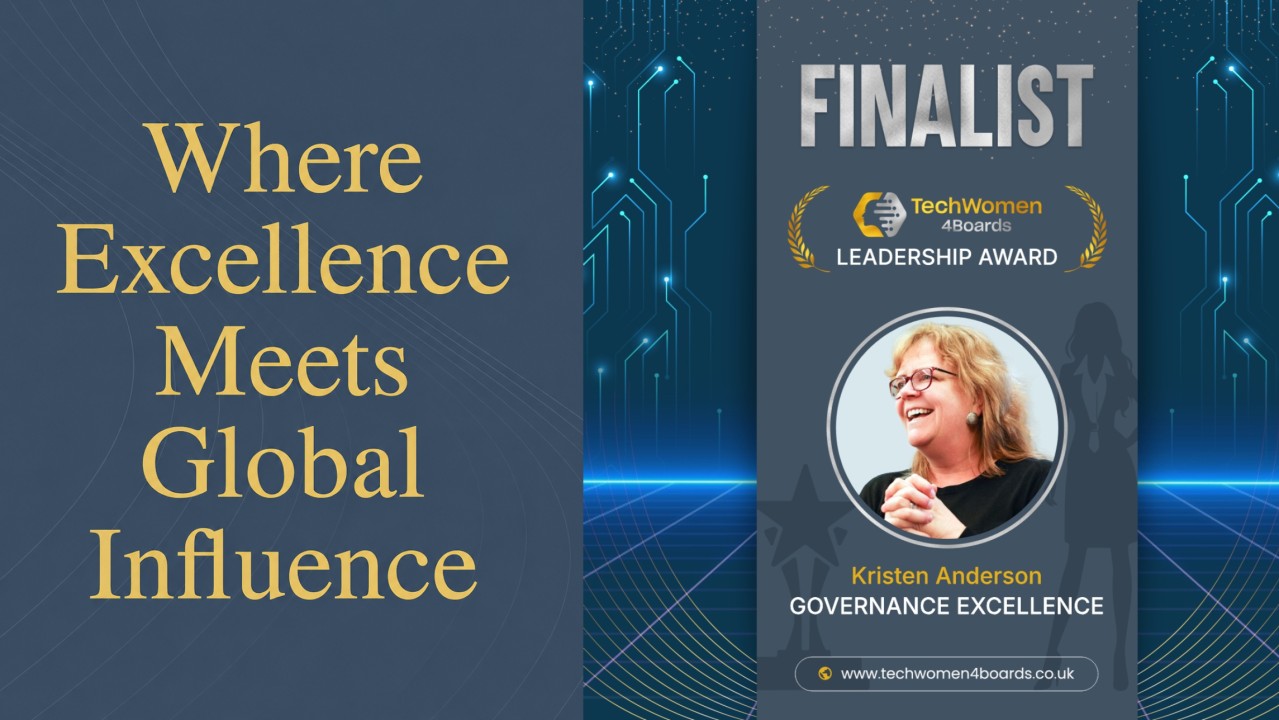
By Kristen Anderson
From an early age, I have been interested in diversity and inclusion, starting from when I lived in Wales. I was the 7-year-old outsider who spoke English, but not correctly (according to my Welsh teachers)! I still remember what it felt like to be excluded—to not have a voice. Fast forward to when I started my career in Chicago as a female chemical engineer in the food industry—the majority were food scientists and male engineers. Later I had the opportunity to live and work in Melbourne, Munich, Shanghai, Singapore and Italy, where I experienced the power of cultural diversity on the R&D teams which I led in the development of food products, packages and processes around the world.
You may be thinking what does this have to do with excellence in governance? I was able to experience board governance for the first time when I was Head of R&D for Australia/New Zealand and a member of the Board. I saw that when a group of people with diverse experiences, backgrounds, cultures come together as a team who actively listen to each other and enable everyone to contribute, the decision-making is better and the business results improve. When I led the Barilla D&I Board, we intentionally created a team with as much diversity (gender, sexual orientation, culture, ability, age, background, etc.) as possible and, with this team, we went on to win the prestigious Catalyst Award for the company.
I am passionate about inclusion on Boards, as I have also experienced the opposite situation where a diverse Board did not perform well because the leader did not include everyone in the discussion. You cannot have excellence in governance if you are not focussing on inclusion of all—this leads to group think. Some might be sceptical, so I challenge you to look at the boards or decision-making teams of companies who have had major crises. Not surprisingly, they are very homogenous…….maybe there is one woman or one person of diverse background. But one voice will not be heard by the majority. As the research shows, homogenous teams do not perform as well or make as ethical of decisions as diverse teams—managed in an inclusive way. This has also been my experience on boards and decision-making teams in 6 countries around the world.
After spending over 30 years in the corporate world, I chose to leave five years ago and devote my time to volunteering with organizations working to increase gender equality on boards—governance, performance, decision-making, CEO succession & compensation, board composition, activist investors—as Board Member/CEO/Vice Chair of European Women on Boards for 4 years and more recently as part of the Leadership Committee of How Women Lead.
I am deeply committed to empowering boards to increase performance with better diversity and inclusion, and I am honoured to be in the company of exceptional female leaders for the TechWomen4 Boards awards.